Burrowing Owls

Owls are fascinating little creatures that have adapted to be skilled hunters that get a lot of human attention. From their fuzzy appearance to big doe eyes, and puppy-like demeaner, it’s hard to have disdain for them! In South Florida we have a native species of owl called the Athene Cunicularia otherwise known as the Burrowing Owl! That species of owl is incredibly unique because it is both one of the smallest and the only one that nests underground. They spend a good portion of their time on the surface watching out for predators, and potential prey they might encounter. 

Living in burrows can have its ups and downs. Burrowing Owls find it to be an ideal place to keep their eggs and young at stable temperatures as they grow. They can start laying their eggs as early as February since we have warmer temperatures! However, during the rainy season, their burrows are at risk of flooding which could lead to the loss of their vulnerable young. It takes approximately 40 days from when they are incubated to when they become adults. The Florida rainy season starts in the summer months, sometimes as early as April. Sometimes these little creatures have close encounters with poor weather and have to abandon their nest for their own safety. 

Burrowing owls are one of the few animals’ species that are entirely monogamous, which means they stay loyal to one partner. So, when it’s time for them to have a family, the male would be the one to stand guard and hunt for food while the female stays inside the burrow and incubates their clutch of eggs. It takes approximately 3 weeks for the eggs to finish the incubation period, and then another week of them growing up to as baby chicks entirely dependent on their parents for survival. They have a unique fledgling phase, which is when they are starting to get more comfortable walking around, and they’d stay by the entrance of their burrow to stretch their wings and observe their surroundings. It’s also where they begin practicing their hunting skills which include pouncing on prey! 

They have unique behaviors when it comes down to their burrows which can be differentiated by whether they are northern or southern Burrowing Owls. Northern Burrowing Owls are migratory and evict animals such as prairie dogs from their burrows to reside in them. They also tend to have more feathered legs which are better suited for colder climates! Meanwhile, southern Burrowing Owls are non-migratory, and so they tend to make their own burrows and reside in them longer-term. Some Burrowing Owls have also been known to cover their burrows in cow manure to both mask their scent from predators and attract dung beetles to their residence. They can also imitate rattle snake sounds to deter predators that get too close!

Burrowing Owls are an excellent natural pest control, primarily feeding bugs and small rodents. They are vital to our ecosystems and truly an intriguing organism! 

Resources –> The Very Strange and Unusual Burrowing Owl

47 Fascinating Owl Facts [2025] | FactRetriever.com

Fascinating Facts About Owls | Almanac.com

Climate Change: Wacky Weather

If you have lived in Florida long, you know the weather can change drastically in a matter of minutes and vary within a matter of blocks. It could be a beautiful sunny day, then clouds spawn from nothing and a heavy downpour ruins your beach plans. Rain, humidity, and warmer temperatures are what we are accustomed to, especially down in South Florida. Each winter we expect a week or two of cold fronts, but things this year were a little strange. Looking at the weather forecast after the short yearly cold fronts passed, just to discover that more were lined up right behind them was something that nobody anticipated.? 

People were struggling to adapt to the consistent cold fronts, but the hardest hit were the vegetable and fruit crops. Citruses, mangoes, and tomatoes are a small portion of the type of crops that took a hit with the prolonged winter South Florida received this past  year. Some portable plants were able to be salvaged by relocating them to a temperature  controlled area like a greenhouse, but the field crops were a different story. Many of those fields with cold-sensitive crops died off, causing millions of dollars in losses.? 

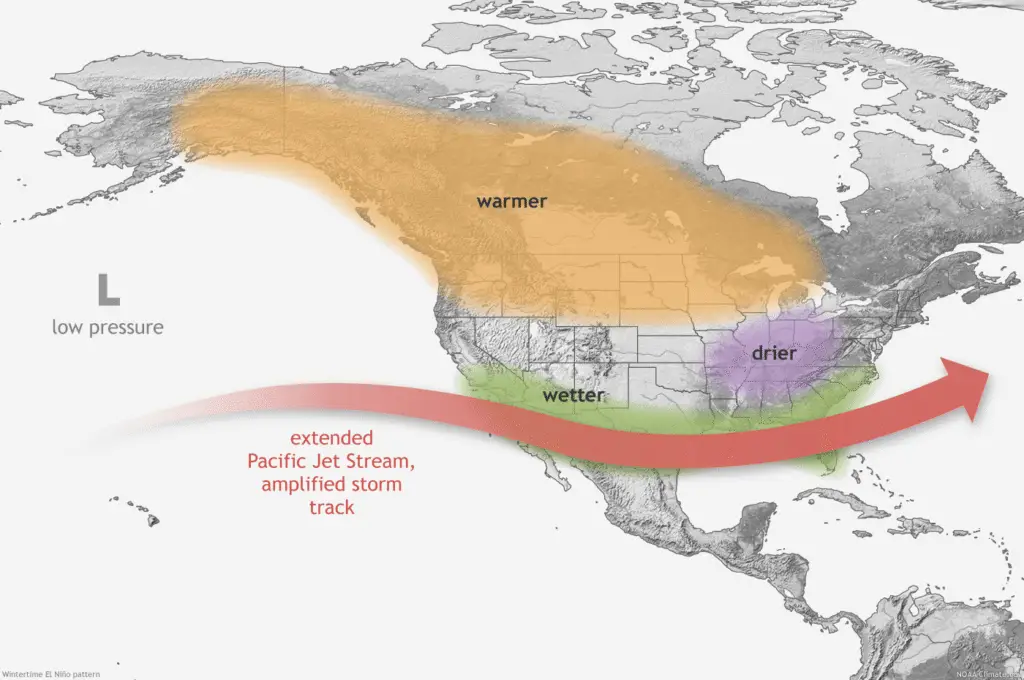
Do these cold fronts mean that climate change isn’t an issue anymore? The fact of the matter is that climate change isn’t as simple as the black and white definition of global heating. It is, however, an explanation for the weather getting more unpredictable. Two of the largest known weather patterns are referred to as El Niño and La Niña which affect trade winds in the Pacific Ocean. Understanding them can be a beneficial way to gauge what kind of weather is going to affect certain geographical locations. El Niño generally impacts warmer winters in the northern U.S. and wetter winters in the Gulf Coast, while La Niña generally impacts colder winters in the northern U.S. and warmer and drier winters in the South. This year, La Niña was significantly weaker and less predictable than usual, which allowed other atmospheric patterns to play a larger role in shaping Florida’s weather. This year it happened to lead to more frequent cold fronts.? 

The Ozone layer is a protective gas (O3) that shields the Earth from harmful UV rays that could negatively impact life on this planet. Ever since the industrial revolution where machines were used to increase work efficiency, an increase in gasses continue to be released into the environment. It is very common for the health of the Ozone layer to be lumped into climate change, but they are actually different environmental issues. Climate change is primarily caused by greenhouse gases that trap heat in the atmosphere, while the ozone simply protects the planet from UV rays that in larger amounts could harm ecosystems. Although separate issues, it is equally as important and with continuous efforts by individual and industry, the ozone layer has been making a steady recovery and by the year 2066, it’s expected to be where it was pre-industrial revolution.? 

What can civilians like you or I do to aid in this fight against climate change? Limiting waste as much as possible by reducing, reusing, and recycling is one of the biggest ways to limit environmental impact. Opting to carpool or walk instead of driving to minimize gasoline usage (Especially in this current economy) reduces the amount of carbon dioxide that is released into the atmosphere. Participating in local environmental opportunities such as trash cleanups and tree plantings is also a wonderful way to help! Although these few actions might seem small, millions of people taking part in those changes can lead to a more beautiful Earth for our future generations to inherit.? 

Resources –>https://www.weather.gov/media/mfl/news/WinterSummary2026.pdf 

What are El Nino and La Nina? 

Current State of the Ozone Layer | US EPA 

What You Can Do about Climate Change | US EPA 

Tropical plants hit hardest after freeze in Central Florida 

Wasps

  A lot of apex predators get a negative reputation such as Great White sharks, American Alligators, and Wasps! Although they are technically apex predators in microecosystems, specifically the insect ones, they still reign supreme. It’s easy to label wasps as pests that seemingly do nothing except survive, but when we dive deeper, we can gain a new understanding of their importance in our ecosystems.

               So, what do wasps do for the ecosystem around us? Like how most apex predators help keep the populations beneath them in check, that’s exactly what wasps do to insect populations that could be harmful to various crops. From Aphids which spread viruses to vegetables and grains, to grasshoppers which can destroy pastures and crops, wasps actively hunt them along with a larger multitude of pests to feed their larvae.

               They are also accidental pollinators! As previously discussed, the wasps feed all the insects they hunt for the larvae for their development. So, what do the adult wasps eat? They either consume a sweet saliva that the larvae produce after being fed, or they consume the sweet nectar that flowers produce. Like how bees pollinate flowers, when a wasp stops to feed at a flower, pollen gets attached to their appendages and thus gets rubbed off on the next flower that they so happen to visit next. While bees are more specialized as effective pollinators because of the hairs, they are covered with that more successfully carries the pollen, they still aid hundreds of plant species pollinate!

               If wasps are so beneficial to our ecosystem, why are they so aggressive towards humans? Like most species on Earth, they are highly protective of their home and food supplies. Wasps like Yellow Jackets are notorious for defending their nest which houses their queen and larvae. If they feel you’re too close, or perceive your movements as an attack, they will likely try to sting you. If they manage to be successful and land a sting on you, or if you manage to kill them, they release pheromones when they sting or die which acts as a distress signal that would alert other nearby wasps to its location.

               So, what should be done when encountering a wasp? The most important thing you can do is to remain as still as you can, so the wasp doesn’t perceive one of your motions as a threat. If there’s a nest on your property, then you could call the National Pest Management Association for tips on what to do or for professional removal options! There are a large variety of wasp types, but at the end of the day they all just want to do what they can for their larvae and survival.

Resource à https://www.nhm.ac.uk/discover/what-do-wasps-do.html

Mushrooms Everywhere

Mushrooms are everywhere! The vast number of species cover a wide range of various jobs either beneficial or harmful to humans or nonhumans alike. Fungi can be responsible for diseases that can affect our internal organs such as valley fever affecting humans which is a lung infection caused by the inhalation of Coccidioides spores, to a fungus known as cordyceps which hijacks an ants nervous system causing them to climb to an appropriate height for the fungus to thus grow its fruiting body and spread its spores to other ants.

So, what benefit does Fungi have towards humans and the ecosystem around us? We can start with plants! Plants play a crucial role in many of our ecosystems because they constitute the bottom of most food chains. Some fungi can attach to the roots of certain plants and thus increase the nutrient and water absorption of the plant while gaining additional nutrients itself. This is referred to as a mutual symbiosis relationship where both parties benefit from. A specific example of this could include various trees such as pines, oaks, and redwoods with soil fungus such as Amanita or Boletus. Fungi alongside plants are part of a process called soil carbon sequestration where excess carbon that is in the atmosphere is captured and stored into the soil. That not only keeps our atmosphere in a cleaner state but also provides fertile soil for new plants.

The human consumption of Fungi is also revealing to researchers its potential for medicinal breakthroughs as more clinical trials is done to depict its effectiveness. Tumors, AIDS, and diabetes are some of the largest health issues human struggle with that are showing promising results using Fungi. It is still currently considered an alternative medicine, but it is extremely promising!

What can we do as a species to protect our fungal communities? Avoiding harsh chemicals and pesticides in gardens could help in not disturbing the balance the microbial communities are attempting to form. Avoid heavy tilling and compacting your garden as to not damage the fungal hyphae or fine fungal threads that form in the soil. Using organic mulch like compost can aid in feeding the soil to create the ideal environments for the fungi to thrive as well! If gardening isn’t your forte, you could always contribute to the global mapping of fungal biodiversity by logging your fungi observations using apps like iNaturalist or a website like mushroom observer! Using those platforms helps researchers gather data that is used to further understand and protect local ecosystems. Mushrooms are fascinating organisms that help keep our ecosystems thriving! Truly fascinating organisms!

Resources  https://www.decadeonrestoration.org/stories/benefits-fungi-environment-and-humans

https://pmc.ncbi.nlm.nih.gov/articles/PMC10296638

Video on ants affected by cordyceps  https://www.youtube.com/watch?v=XuKjBIBBAL8

Invasive Species

South Florida’s ecosystems are under growing pressure from invasive reptiles, and much of the problem starts with people. The exotic pet trade remains the primary pathway—when owners release pets, intentionally or not, those animals can establish and spread in Florida’s favorable climate. 

More than fifty non-native reptile species now live in South Florida. While not all are harmful, species like Burmese pythons, green iguanas, and tegus cause significant ecological damage and are considered invasive. 

If you encounter one, stay calm and keep your distance—especially with large species. If it’s safe, take a photo and report it using the IveGot1 app or by calling 1-888-IVE-GOT1. Never attempt to capture the animal; that is dangerous and should be left to trained professionals. 

Prevention starts with personal responsibility. If you choose to own an exotic pet, research its needs before bringing it home and commit to caring for it for its entire life. When circumstances change, rehome the animal responsibly—never release it into the wild. If you need help, contact the Florida Fish and Wildlife Conservation Commission’s Exotic Pet Amnesty Program. 

Invasive species are a human-driven problem, which means they require human accountability. Responsible choices—before and after pet ownership—are the most effective way to protect Florida’s ecosystems. 

https://myfwc.com/wildlifehabitats/nonnatives/rule-development

https://www.fws.gov/story/2025-05/managing-invasive-reptiles-south-florida

Does This Bird Need My Help?

It’s that time of the year when flowers are in bloom, pollinators are busy tending to the land, and babies are everywhere! From land to the skies, late spring throughout summer is the season for the newer fauna generations to put their adaptations to the test. Maybe you find yourself outside on your porch watching the sunrise when you hear frantic chirping coming from the bottom of a tree. Your instincts kick in, and you rush to the noise to spot a bird that you assume tragically fell from the nest with no way of surviving. But wait, before you rush to gather some towels and a shoe box to rescue the flightless bird, take a moment to truly take in the sight before you.? 

There are three different stages of a bird’s life that are split up by their age approximations. Once a baby bird hatches, they are known as hatchlings. In this phase, their mouths can open and receive the food their mother catches for them, but their eyes remain closed. They also don’t have any feathers yet, so their dependency is very high. Typically, this phase gives us the approximation that they are roughly 0-3 days old. 

The next stage in the life cycle of a baby bird is when their eyes are finally open, feathers are sprouting, and they are more energetic around the nest. This phase is referred to as the nestling phase, which can tell us that they are roughly 3-13 days old. They still want to remain in the nest with their family; it’s the equivalence of a toddler.? 

Lastly, the part in their life where they get confused as babies in need that have fallen from the nest is known as a fledgling. This phase typically occurs when they are 13+ days old, and they seemingly look like a fully feathered adult bird. Their parents are also likely to still be nearby caring for them from a distance. The main difference between a fledgling and an adult bird is the fact that the fledgling is a flying novice. It’s kind of like the awkward teenage phase that all birds must go through. Just like a human needs to learn to walk and falls down a few times before they get the hang of it, a bird will take a few crash landings before they can properly dominate the skies.? 

So, what should you do when you spot a bird in their various life cycles? If they are a hatchling or nestling and they are spotted on the ground, cautiously locate the nest and place them back in. If they are a fledgling, try to be mindful of the flight school final exam they are about to take.?When in doubt, try to get into contact with your local wildlife rehabilitator (such as Sawgrass Nature Center and Wildlife Hospital). They will gladly be able to accurately answer any questions you may have and guide you towards the best route to take for the safety and well-being of that bird’s life.

References:? 

https://www.youtube.com/watch?v=Pv2iVX9AHw4 https://www.massaudubon.org/nature-wildlife/birds/baby-birds-out-of-the-nest

Celebrating Earth Day with EarthFest!

It’s that time of year again where all your nature-loving, tree-hugging friends and family get loud about their care for Mother Earth. Earth Day shows up every year on April 22nd, but here in South Florida, it doesn’t always look like the pictures you might expect. There’s no thawing snow or first signs of spring. Instead, we’re slowly easing into the upcoming wet season of summer. The air is a little warmer, the skies a little brighter, and if you look closely, nature is already in motion. Pollinators are busy at work, plants are pushing out new growth, and wildlife is adjusting to longer, hotter days ahead. At the Sawgrass Nature Center, however, Earth Day isn’t a reset button, it’s part of an ongoing rhythm.

Caring for the Earth isn’t something that happens once a year. It’s something that builds slowly, in small moments, over time. It’s an active choice you make every single day, a shift in your state of mind. It can be the choice to plant native species instead of something ornamental, noticing the butterflies in your yard, or even a child’s curiosity turning into respect, and then into stewardship. It’s a relationship, and like any relationship, it doesn’t have to start big. It can be overwhelming when trying to decide where to begin, but don’t be afraid to start small! That can look like planting something native, even if it’s just one pot on a patio, putting out a shallow dish of water for wildlife, turning off outdoor lights a little earlier to help nocturnal animals, taking a walk and simply noticing what’s growing, flying, or crawling around you, and sharing what you learn with someone else. These actions might seem simple, but here in Florida’s ecosystems, they matter more than you might think. Our native plants support pollinators, our green spaces provide refuge for wildlife, and our everyday choices shape the spaces we all share.

Earth Day isn’t about doing everything perfectly. It’s about choosing to stay connected. And if you’re looking for a place to start (or to keep that connection growing), we’d love to see you this Saturday at our EarthFest event here at the Sawgrass Nature Center and Wildlife Hospital! It’s a chance to get your hands a little dirty, learn something new, and spend time with people who care about this place just as much as you do. Click the link below for more information! Remember, Earth Day may only come once a year, but being part of it can happen anytime.

EarthFest in Coral Springs, FL

Camp WILD’s Collaboration with Wildlife Rehabilitation

As temperatures continue to rise here in South Florida in preparation for the summer season, our community has been met with the plentifulness of spring all around. Blooming flowers, crawling critters, fledgling birds learning to fly, baby raccoons and opossums, and so much more hidden abundance come with the arrival of spring. Here at the Sawgrass Nature Center, we welcomed this new season with a celebration of new seasons at our Spring Break Camp WILD!

Throughout camp we learned all about the parts of a flower and pollination while making our own homemade cardboard flower vases to fill with the colors of spring. We used our big scientist brains to discuss the physics behind a rainbow and even made our own spectroscopes. We’ve got some real smarty-pants campers here! We had a visit from our wildlife rehabber, Ms. Tina, and a bunny rabbit from the wildlife hospital. And most notably, our spring break campers left their permanent mark here at the nature center during this break camp. Working together, we helped paint an essential tool used in one of our animals’ habitats. Bubba, our African Spur-Thighed Tortoise, requested that our campers add their own creative flare to his brand-new backscratcher. So, we did just that!

Tortoises might have tough, protective shells, but that doesn’t mean they don’t get a little itchy now and then! For species like the African spur-thighed tortoise, their shells and skin can trap dirt, shed skin, and even tiny irritants that they can’t easily reach or rub off on their own, especially in a managed enclosure without all the natural textures they’d encounter in the wild. That’s where a good “backscratcher” comes in! Providing a safe, textured tool gives them a way to scratch, stretch, and engage in natural behaviors that support both their physical comfort and mental enrichment. So, while it may look like a simple, silly object, a backscratcher is actually a really important part of helping our tortoise stay happy, healthy, and itch-free, and now, thanks to our campers, it comes with a personal touch!

Moments like this go far beyond a simple craft. They create meaningful connections between our campers and the animals in our care. By taking part in something that directly benefits the tortoise, campers get to see how even small actions can make a big difference in an animal’s well-being. It turns creativity into compassion and curiosity into stewardship. Experiences like these help foster a deeper understanding of animal care, enrichment, and respect for wildlife, which is at the heart of the Sawgrass Nature Center mission. Next time you stop by the SNC to visit Bubba, we hope you see it’s not just a painted backscratcher, but an outlet to inspire the next generation to care for the natural world in thoughtful, hands-on ways.

Nature’s Romance: The Wild Courtship Rituals of the Natural World! 

Valentine’s Day isn’t just about roses and chocolates. Although these may work for humans, wildlife find countless other ways to impress their partners.  In the natural world, it’s about hooting, dancing, decorating, and sometimes building an entire art installation just to impress someone. In different ecosystems around the world, and even right here in Florida, animals are putting on some of the most dramatic courtship performances you’ll ever see. Below, we dive into some of nature’s boldest romantics. 

The Great Horned Owl doesn’t wait for spring. In Florida, these owls begin courtship in winter. Pairs call softly back and forth in deep, echoing duets, strengthening bonds that can last for years. If you’ve ever heard that haunting nighttime hoot, you might have been listening to a Valentine’s serenade. 

The Sandhill Crane, a familiar sight in Florida fields and wetlands, takes romance to the dance floor. They bow, leap high into the air, toss sticks, flap dramatically, and call loudly in synchronized displays. It looks joyful and a little chaotic, but it reinforces pair bonds and shows off strength and coordination. 

The American Alligator prefers something a bit louder. During mating season, males and females release a deep bellow that vibrates the water’s surface. The low-frequency rumble can be felt as much as heard and is basically a swamp opera!  

Outside Florida, there are many astounding rituals that may leave a human wondering but leave an animal blushing! Male Bowerbirds are a great example. However, they don’t just dance…they build. In Australia and New Guinea, males construct elaborate “bowers” out of sticks and decorate them with brightly colored objects like flowers, shells, berries, and even bits of colorful plastic. Some species even arrange items by size to create forced perspective, an optical illusion to impress females. 

Birds-of-paradise are legendary for a reason. Males clear a stage area, groom every feather into place, and perform intricate dances that involve snapping, bouncing, wing-flicking, shape-shifting silhouettes, and hypnotic head movements. Some even transform into what looks like a floating black oval with neon highlights. 

Although many do, not all avian courtship rituals involve dance or large displays. Male Adelie Penguins present females with carefully selected pebbles. If she accepts the stone, she may use it to help build their nest. 

As funky as these rituals seem, they serve an important purpose. Courtship displays signal health, strength, creativity, and good genetics. The more impressive the performance, the more likely an animal is to pass on its traits. And when we see these behaviors happening, from Florida wetlands to tropical forests, it’s a sign that habitats are healthy enough to support new life. So, this Valentine’s Day, as we celebrate love in our own way, remember that nature has been celebrating Valentine’s Day long before we gave it a name, and honestly, it does it with a lot more flair.  

Here are some videos to provide a visual of some of these unusual and mesmerizing rituals! 

The Science Behind Groundhogs and Their Shadows! 

Every year in early February, when Americans are shivering and ready to welcome the warmth of spring, all eyes turn to a groundhog and its shadow. Will there be six more weeks of winter, or an early spring? While Groundhog Day is rooted in tradition and folklore, the real story of groundhogs is far more interesting, and surprisingly connected to the seasonal changes happening all around us. 

Groundhogs, also known as woodchucks, are true hibernators. During the coldest months, they spend weeks at a time in underground burrows, slowing their heart rate and body temperature to conserve energy. But by late winter, things begin to change. As daylight increases, groundhogs start to stir. They may briefly emerge from their burrows, not to predict the weather, but to check conditions and prepare for the upcoming breeding season. This early activity is one of nature’s subtle signs that spring is approaching, whether the calendar (or the shadow) agrees or not. 

Although they have been simplified to a holiday mascot for most, groundhogs play an important role in the ecosystems where they live. Their burrowing helps aerate soil, mix nutrients, and create shelter used by other animals like foxes, rabbits, and amphibians. In this way, groundhogs act as quiet ecosystem engineers, shaping their environment from below the surface. 

Although groundhogs aren’t native to Florida, we do have our own burrowing wildlife filling similar roles. Gopher tortoises, for example, dig deep burrows that provide shelter for more than 350 other species. Armadillos also disturb soil as they forage, influencing nutrient cycling in their own way. Different species, same idea: healthy ecosystems rely on keystone species that shape the land itself. 

Groundhog Day may be playful, but it reminds us of something deeper: nature doesn’t wait for a date on the calendar. Across the country (and right here in Florida), wildlife is already responding to longer days and subtle environmental cues. Nesting seasons are approaching, plants are preparing to bloom, and animals are shifting into a new phase of the year. So whether or not the world’s most famous groundhog saw its shadow this year, we know the natural world is already planning ahead.