
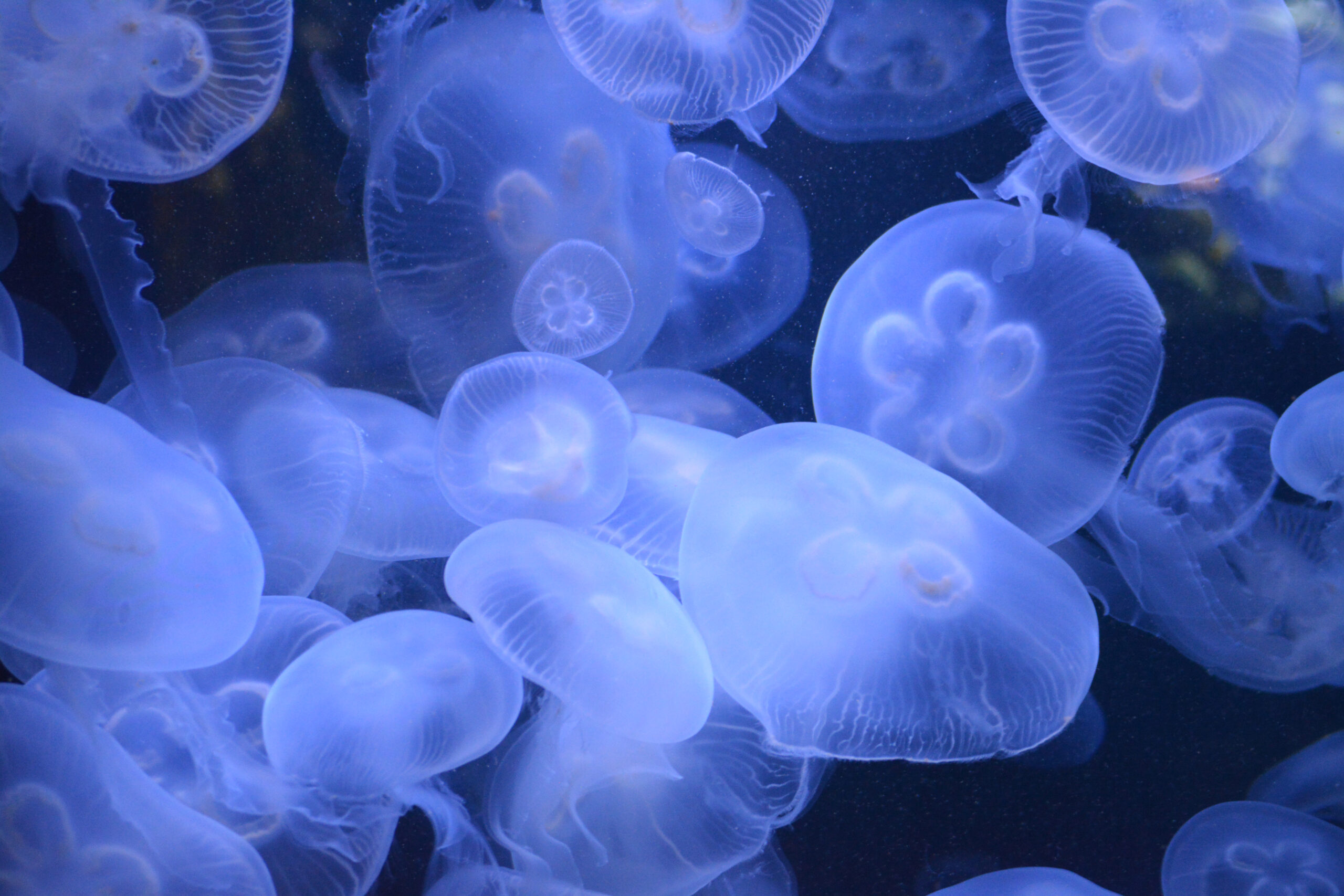
Jellyfish seem like such an enigma. They seem to be gelatinous blobs that float around mindlessly throughout ocean environments. In fact, jellyfish play an intricate role in the ecosystems they inhabit. There are over 2000 known species of jellyfish, and likely many more, since the majority of the ocean organisms are yet to have been discovered. Interestingly, out of the 2000 species we have discovered, roughly only 70 species produce a sting that can hurt humans. Moon jellyfish, which are shown in the image above, are a common species of jellyfish whose sting cannot penetrate human skin.?
????The stinging cells that jellyfish possess are known as nematocysts, which aid in their ability to capture prey. Jellyfish fall under the phylum Cnidaria, and other organisms in this phylum produce their own nematocysts. However, some organisms like sea slugs consume jellyfish and other Cnidaria to use as their own form of defense. Sea slugs have a tough chitin-lined digestive tract, which helps protect the organism from the stinging cells’ potency. Instead of digesting those cells, they are instead transported to the tips of the projections on their back to then be used for their own defense. The process of taking the Cnidarians’ stinging cells to be used by the organism consuming them is known as kleptocnidy. Two other organisms that practice kleptocnidy include flatworms and comb jellies.?
???? When jellyfish die, their carcasses sink to the ocean floor relatively fast. Since their bodies consist of a significant amount of carbon deposits and sink at a fast rate, this ensures that it isn’t lost in the upper oceanic layers. The carbon is then stored in the sediments of the ocean floor for a long time. To put that into perspective, roughly 3.7 – 6.8 billion tons of carbon a year are stored in ocean sediment by jellyfish impact alone. The carbon that is stored in the sediments is able to provide nutrients for various bacteria and crustaceans that otherwise wouldn’t be able to get it from the ocean surface.?
??Anything that jellyfish consume goes out in a usable form for other organisms after they die. During jellyfish blooms, which are when there is a vast amount of a jellyfish population at one time, they consume a large number of plankton and thus continuously store those nutrients in their body. When they pass away or excrete waste, it comes out as nutrients that continuously fuel more phytoplankton growth!?
????It can be so fascinating to dive into a specific organism and see how they impact their environment.? Jellyfish are fascinating creatures that have a wonderful job in nutrient cycling and carbon sequestration!?
Resources –>?https://pmc.ncbi.nlm.nih.gov/articles/PMC2783962/