If 2020 has taught us anything, it’s how to entertain ourselves within the safety of our own home. Recreating some social favorites isn’t always easy, but here’s one thing that is: a wine tasting. Pair some of your favorite wines with a homemade charcuterie board! A charcuterie board is an ensemble of foods that typically pair well with wines. Some popular options are cured meats, nuts, cheeses, fruits, crackers, and even honeycomb.
That’s right! Not only can honey from the honeycomb be used as a delicious sweetener, it can also be used as a crunchy snack that pairs excellently with white wines like a sauvignon blanc. Honeycomb is a unique and creative feature of a wine tasting that is not often used outside of specialty restaurants. You will be able to expand your palate while providing a fun experience for yourself and your friends!
Since honeycomb can be sourced without harming a beehive, you can find ethically sourced, organic honeycomb pretty easily. This unique purchase can even go towards helping local bee populations.
Bees have a very important role in the environment as pollinators. That means they are responsible for distributing plant pollen, or reproductive material, to each plant they land on. This transportation ensures the continued growth of new plants. Since plants produce the oxygen humans and other animals need to breathe, this is a pretty important job.
If you are looking to create a fun at-home event and support local bee populations at the same time, the Sawgrass Nature Center offers all natural, ethically sourced honeycomb from our onsite apiary. The proceeds go directly back to supporting local bee populations across Broward County! Call 954-752-9453 (WILD) for more details.
There is a lot of slime in nature and so many animals that use slime in different ways. One of my favorite activities to do with students when learning about these animals is to make Oobleck! It is an easy, fun craft that gets kids immersed into the experience of using slime in their own way. It gives them a hands-on example of how this sticky substance can be useful in nature.
What we call slime, is more accurately referred to as mucus. You may be able to list a few different animals already that use mucus: frogs, snails, slugs. These animals rely on mucus to keep their skin moist and hydrated. But did you know that opossums use mucus too? That’s right! Because opossums are prey type animals, they have a bunch of different methods of self defense. This includes secreting a stinky, slimy mucus from their bottoms to scare off larger predators when threatened.
These are the fun facts I teach my students while I prepare them for their craft. To make slime at home you’re going to need a few items.
Cornstarch
Food Coloring (your choice)
Water
Your proportion is essentially going to be 2:1 ratio cornstarch to water, but I think part of the fun is letting the kids figure out the proportions for themselves. This gives them a chance to learn about balance and the effectiveness of slime being just moldable enough without it being too dry or too wet.
Once you and your little scientist-in-training have completed your craft, come on out to the Sawgrass Nature Center and tour our exhibits. This is a great chance to create your very own scavenger hunt by looking for animals that use their own type of slime! Let us know what you find.
Our Spring Break Camp Wild registration is now open! Click here to register.
We’ll be the first to admit that sometimes trying to lead a zero-waste or organic lifestyle comes with a cost association. But in a year such as this, or any other year you might have a tight budget, there’s no need to feel guilty about not spending more to do more for the environment. In this article we will discuss some easy, affordable ways to reduce your waste footprint on the planet that won’t have you breaking the bank.
Why should I care about a zero-waste lifestyle?
As of 2020 scientists are finding micro-plastics in everything. The fish we eat, the coral reefs we snorkel on, and littering the beaches we in Florida love so much. I don’t know about you but drowning in a sea of plastic does not sound like something in which I want to partake. There’s a whole list of examples of how plastic pollution is affecting our economy and our bodies, but that’s for another article at another time.
Easy changes to make toward a zero-waste lifestyle:
This one might seem like a no-brainer, but it is one of the biggest: stop buying multiple packaged water bottles. Filters that can be reused again and again are more cost efficient and save lots of plastic overtime. If you still need the convenience of a water bottle, invest in a reusable water bottle instead.
On a similar note, coffee/tea drinkers bring your own coffee cups. Some of you have already hopped on this trend with reusable cups offered by your preferred coffee shop. This is a cheap and easy investment that can even be personalized depending on your preferred café. Many even offer monetary incentives for bringing in reusable cups. If you are more of a tea drinker, try investing in loose tea leaves and a reusable infuser.
Use reusable straws or no straw at all. Plastic straws were not common until the late 1960s. Before then, straws were mostly used (paper ones) for milkshakes or root-beer floats. Out of the seven reusable straws I have, I have never paid a dime for any of them. Each was found as a free take-away at non-profit events. While some are pretty affordable on their own, if this luxury item is not something you cannot splurge on at the moment, check local nonprofits in your area that may provide them for you.
If you’re picking up take-out, try opting-out of plasticware. The more you replace plastic cutlery with metal cutlery that can be washed and reused, the better.
It might not seem like a lot, but a small effort done by the many is a large effort at the end of the day. Always remember the term reduce, reuse, recycle, is in that order for a reason. Try looking for ways to cut out plastic in your life. What you can’t reduce, try to reuse, and if can’t do either, try to recycle.
Among Us is an online game that has become a sensation almost overnight. As the name implies, the game is focused on discovering the Imposter among the players before they are all killed. During this investigative process, players are also responsible for completing several tasks aboard their spaceship. When Camp Wild campers excitedly used their free time during snack and lunch to discuss the game with their fellow campers, I knew we could use this concept in our curriculum.
The next morning I set up tasks all around the education area of the nature center. The first station was a plastic frog dissection, fully equipped with all the vital organs typically searched for on live dissections with less mess. The goal of the second station was to organize the ladybug life cycle. The third station, the ”electricity station”, had corks painted in primary and secondary colors and attached to strings. For this station, campers had to “rewire” correctly by tying two primary colors to the secondary color they would make when blended. The fourth station was a fish tank that needed to be refilled and restocked. Campers quickly figured out the rain barrels stationed outside could provide them with the water necessary for this task. The fifth task was to assemble “solar panels,” or sun catchers out of marbles for clean energy. The sixth task was a bit more involved.
Since we are an environmental camp based out of a nature center, the setting of the game was a nature center where the campers were playing the role of Wildlife Rehabilitators. Throughout the week they learned different types of animal classifications. Calling on this knowledge for the sixth task, wooden hearts representing “medicine” were scattered around the outdoor education area. Each time one heart was found, campers would have to sit down together and identify an imaginary animal to give it the proper course of treatment. They were given hints like “it’s cold blooded,” or “it’s a reptile,” and if they could properly identify the animal under a certain amount of time, they would successfully earn the medicine heart they found. If there was an animal that could not be properly identified, the medicine hearts were scattered and the task would start over again.
Each task was created with an educational intent, but the campers were having so much fun, they didn’t even realize the valuable lessons they learned. The rounds were easily set up again after each imposter either won or was voted out of the nature center. For added fun, we let the campers create their own name tags in association with game colors.
With respect to COVID protocols, all of the tasks were sanitized between campers and a limit of no more than two masked campers to each task allowed them to maintain social distance outside of their assigned seats. A fun, safe game and a successful educational tool that related back to something the camper’s already enjoyed guaranteed a successful event that is sure to be recreated for camps in the future.
If you are a high school student, volunteering is probably a requirement for graduation. Finding an organization to volunteer with can be challenging, especially during a global pandemic. There are a couple of resources that can help you find opportunities. Before we get to those, I want to encourage you to think about your interests and what you hope to get out of your volunteer experience. I also want to encourage you to look beyond fulfilling a graduation requirement. Volunteering provides you with experience that you can list on your resume and if you stay with an organization for a while, it can lead to references and letters of recommendation. I always remind my volunteers to treat their volunteer position like a job. Just because you are not getting paid does not mean you’re not acquiring work experience.
Where to look
Hands on Broward is a database of volunteer opportunities in Broward County and it allows users to search for opportunities based on their interests and location. Volunteer Connect is Volunteer Florida’s opportunity portal. It runs on the same software as Hands on Broward and is another resource I recommend to anyone interested in volunteering.
Different organizations use these platforms in different ways. At the Sawgrass Nature Center and Wildlife Hospital we use Hands on Broward to recruit episodic volunteers. This means that volunteers that sign up for these opportunities are not making a long-term commitment to us. You can volunteer once or multiple times, but you are limited to the dates and times posted.
If there is a specific organization, you are interested in start by visiting their website. Often, organizations will have volunteering information online. Be sure to read the requirements carefully and follow the instructions provided. If you have questions give them a call or send an e-mail if one is provided. Depending on the organization some volunteer opportunities will have age requirements. For example, our volunteer program has two different tracks based on age: Junior Volunteers are aged 13-17 and Adult Volunteers are 18 and older.
How to be a great volunteer
I am fortunate to work with amazing volunteers daily. They show up and do great work every single day. Our most successful volunteers understand our mission and how it relates to their assigned position. It is for this reason that I encourage volunteers to find something that aligns with their interests and goals. Please start your search early so that you are not scrambling to complete your hours with only months left to spare. Due to Covid-19 a lot of volunteer programs are operating at a limited capacity if they are operating at all.
Lastly, use volunteering as an opportunity to practice important skills such as speaking on the phone and writing professional e-mails. If you need to excuse yourself from a shift or need to ask a question it is a good idea to do it yourself rather than rely on an adult to do it for you. I love hearing from my volunteers and I especially like to see students taking an active role in the management of their volunteer role.
The Everglades Snail Kite is a hallmark of Florida wildlife. Found in central and south Florida, this magnificent bird of prey thrives in swampy, wetland habitats (Audubon Society, 2020). Unfortunately, due to a myriad of reasons, the population of this seasoned hunted has dropped at an alarming rate.
The Everglades, a vital habitat to the Snail Kite, has been significantly reduced in size due to expanding infrastructure and construction of surrounding human populations (National Park Service, 2019). Fortuitously, organizations such as the Everglades Foundation have worked tirelessly throughout the years to restore and conserve the Everglades which is home to many of Florida’s unique species. (TheEverglades Foundation, 2020).
But habitat loss is not the only struggle the Everglades Snail Kite faces. Their curved beaks are adapted specifically to feed on its namesake: Florida Apple Snails, or Pomacea paludosa. While there are several species of Apple Snails currently located in Florida, Pomacea paludosa is the native species of apple snail to Florida. There is some debate over whether local populations of the Florida Apple Snail may be a separate species from Pomacea paludosa (Schad, 2018), but we will only be referring to Pomaceapaludosa for the purpose of this article.
One might think that the addition of new types of apple snails to Florida would mean the expansion of food for the Everglades Snail Kite, but that does not seem to be the case. Their beaks are so specifically adapted to the smaller, curved shells of the Pomacea paludosa, that the Everglades Snail Kite cannot use its beak successfully to feed on larger species of Apple Snails that are invading Florida wetlands. This poses another problem where the larger species of invasive apple snails are outcompeting and displacing the smaller Pomacea paludosa. The Everglades Snail Kite is facing food loss in addition to habitat loss.
But all is not lost. Harbor Branch Oceanographic Institute, located in Fort Pierce, Florida has successfully completed research on the practice of captive breeding the Florida Apple Snail with a long-term goal of finding ways to replenish wild populations of Pomacea paludosa (Garr, Amber, Helen Posch, Margaret McQuillan, Megan Davis, 2012). These practices, if safely regulated and approved, could be used to help replenish the population of the Everglades Snail Kite by providing it with more food. Regulations and controls are needed to ensure that captive populations would not introduce new bacteria, or diseases to wild populations.
The Everglades Snail Kite is not the only endangered species in Florida, but it is a wonderful example of how—when united—people have the chance to improve many environmental problems.
Audubon Society, 2020. The Everglades Snail Kite. Audubon Florida.
Schad, Morgan. 2018. The Discovery of a Forgotten Species in an Unexpected Location: Pomaceamiamiensis in Palm Beach County. Harriet L. Wilkes Honors College.
The Everglades Foundation, 2020. About. [https://www.evergladesfoundation.org/about]
Garr, Amber. Helen Posch. Margaret McQuillan. Megan Davis. 2012. Development of a captive breeding program for the Florida apple snail, Pomacea paludosa: Relaxation and sex ratio recommendations.
Hi! My name is Abby De la Rocha and I am the Volunteer Coordinator at the Sawgrass Nature Center and Wildlife Hospital in Coral Springs, Florida. I was born in Puerto Rico and lived there until my family moved to Botswana when I was 8 years old. I returned to Puerto Rico when I was 16 and finished high school in Ponce. I then moved to New Orleans where I studied at Loyola University. I have been in Florida since 2006.
In this post, I’m going to tell you about Hispanic Heritage month as well as some interesting facts about Puerto Rico’s agriculture and its most precious ecosystem El Yunque.
What is Hispanic Heritage Month?
Each year, we observe National Hispanic Heritage Month from September 15 to October 15 by celebrating the histories, cultures, and contributions of American citizens whose ancestors came from Spain, Mexico, the Caribbean, and Central and South America.
This year’s Hispanic Heritage Month theme- Hispanics: Be Proud of Your Past, Embrace the Future – invites us to embrace our backgrounds, to be proud of who we are and where we came from.
Embracing the Future
The future of agriculture in Puerto Rico
Currently, Puerto Rico imports 85% of its food. This is a huge vulnerability for an island with a population of 3.1 million. For several years, my family has been involved in the agroecological movement which seeks to increase the self-sufficiency of Puerto Rico through their agricultural project Finca El Reverdecer. This movement has been largely spearheaded by young people who are eager to make a difference. I believe that by looking at our past we can create a better future.
The present agricultural reality of Puerto Rico can be traced back to Puerto Rico’s history as a Spanish colony and later as a Commonwealth of the United States. The establishment of the monoculture of sugarcane meant that many Puerto Ricans worked on sugarcane plantations. My grandfather worked cutting cane during his youth. Later, he would go on to own land that he cultivated for his own consumption. At the age of 93 he continues to enjoy getting his hands dirty on my parents’ farm.
Eventually, the sugarcane industry on the island collapsed. Its demise was due to various factors including hurricanes that decimated the island as well as policies imposed by the Federal Government. In particular, a land tax imposed in 1901 known as the Hollander Bill. As a result of this bill, many local farmers were forced to sell their land. This eventually led to mass migration from the island to the mainland. It also led to a decrease in farming in general as people did not have land to farm. Subsequently, attitudes towards farming became unfavorable, especially among young people. This is changing. Today, many small farms produce high-quality products that are sought out by individuals and restaurants alike. While still a work in progress, the path to agricultural self-sufficiency is being forged.
Celebrating the only U.S. National Forest located on an island
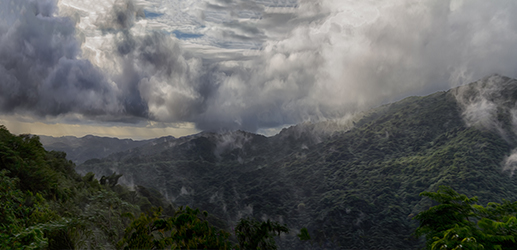
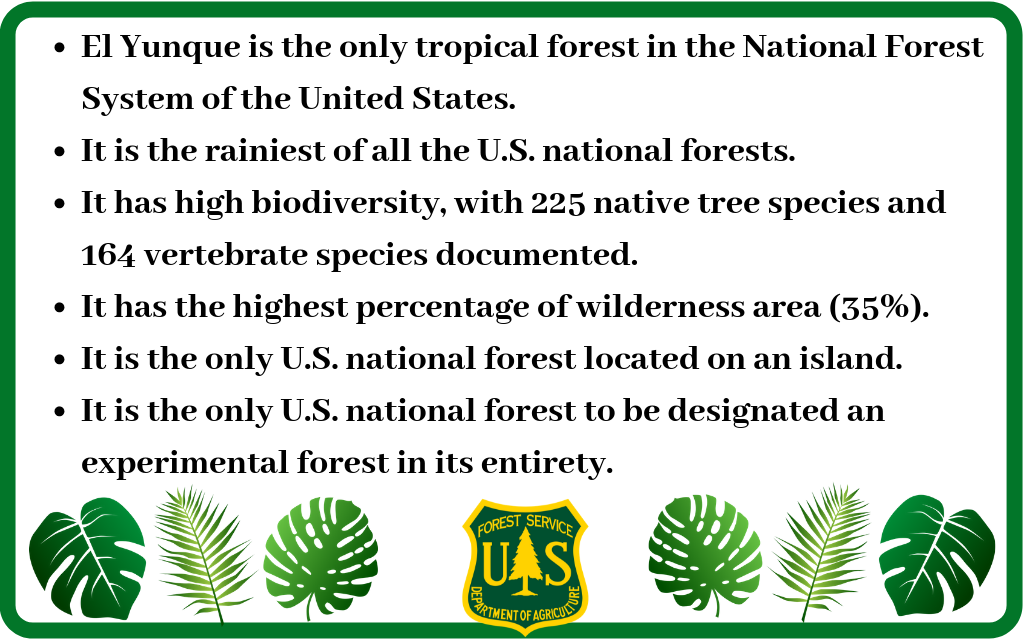
The El Yunque National Forest is the only tropical rainforest in the national forest system. At nearly 29,000 acres, it is one of the smallest in size, yet one of the most biologically diverse.
Photo by United States Department of Agriculture Forest Service retrieved from https://www.fs.usda.gov
The United States Department of Agriculture Forest Service. (2020) describes El Yunque, “Caressed by gentle easterly winds the forest has an average temperature of 73° F, and seasonal changes are almost imperceptible. It is the ideal climate for exuberant tropical vegetation. The rain forest is noted for its biodiversity; it is “home” to thousands of native plants including 150 fern species, 240 tree species (88 of these are endemic or rare and 23 are exclusively found in this forest). The El Yunque National Forest has no large wildlife species, but hundreds of smaller animals abound in this gentle forest, many of which exist nowhere else on the planet.”
Image from United States Department of Agriculture Forest Service, retrieved from https://www.fs.usda.gov
To embrace the future, we must plan and prepare for it. Looking forwards requires us to look back at our history so that we can make sense of our present. Puerto Rico’s future is being planned by those who work the land in order to provide food for its people as well as those who work to preserve the natural wonder that is El Yunque National Forest.
If you’d like to learn more about some of the agricultural projects on the island check out the links below:
Interested in supporting a mighty cause? The Sawgrass Nature Center is working hard to bring free environmental education and career building resources to Title I students in South Florida. As our community begins to recover from a wicked pandemic, we believe that it is important to lend a hand to the families most impacted by it.
The Sawgrass Nature Center is participating in A Community Thrives, a program that supports community improvement ideas with grants up to $100K. To qualify for a grant, we need to meet a fundraising goal from our own network. Help us raise awareness and funds for our project by making a donation online from September 21st through October 16th.
The goal of our project is to bring environmental education to students through a virtual adaptation of our educational programs such as Meet Your Wildlife Friends. Programs like this are typically offered to students at an average minimum price of $180. We want to be able to bring these resources to Title I schools that do not have the funds to pay for the programs themselves in the form of a four-step program or two-step program.
The four-step program will be geared towards older students with the first two steps being a volunteer and professional skill building workshop. The third step will be a professional education program that provides them with an opportunity to get an immersive experience in environmental science. The fourth step is a volunteer opportunity at the Sawgrass Nature Center’s own community garden. This will grant students experience in agriculture, hands-on work, and time in a professional environment.
The two-step program will be developed for a younger crowd. The first step will be an optional craft seminar that is adapted to the teacher’s curriculum and our animal friends. The second step will be the Meet Your Wildlife Friends program, where we bring out our Educational Animals for students to interact with and learn about.
Our community needs resources for dynamic virtual learning opportunities that will complement their regular instruction. We believe it only fair that the resources we offer be made to as many students as possible regardless of socio-economic distinction.
When it comes to community building, the Sawgrass Nature Center believes in a bottom-up effect. Students in our community are the next to step into the work force, the next to inherit the world we leave behind for them. The future is in their hands. Our program shares with them education on nature around them and how to best be responsible for our environment and the wildlife that inhabit it. Our goal is to also provide older students with the skill and professionalism necessary to put that education to best use in the workforce and higher academics. We believe we are watering the seeds of future growth.
Help us grow the future of South Florida through the Mighty Cause Foundation by donating below. Click here to learn more about our campaign.
Recently, people have had more reasons to stay indoors than ever before. It is important that we keep our health and safety at the forefront of our priorities. But it is also important to remember the effect that being inside for too long can have on you. Being outside and connecting with nature has proven benefits to your health.
Fact, nature walks can improve your memory. Have you been feeling scatter brained the more cooped up you have been in your house? A study done in 2008 by psychologists Marc G. Berman, John Jonides, and Stephen Kaplan ran experiments to show that walking in nature can improve memory, or what they refer to as “attention restoration theory.” (1)
Fact, nature can improve your health. I don’t just mean by extracting important medicine from vital plants, or essential oils. I am talking about Vitamin D directly from the sun. Just because we do not photosynthesize like plants, doesn’t mean we do not gain anything from a little sunlight. Vitamin D is necessary to our body and, according to Harvard’s Health Department, is potentially linked to fighting diseases like cancer. (2)
Fact, walking through nature can relieve stress. Scientists led by Liisa Tyrvainen of the Finnish Forest Research Institute ran a psychological investigation into the psychological impacts being in nature had on stress levels. Their findings “suggest that even short-term visits to nature areas have positive effects on perceived stress relief compared to built-up environment.” (3)
Fact, outdoor time is imperative for childhood development. According to the Child Mind Institute (4), playing outdoors is important to children for a variety of reasons such as reducing stress and fatigue, to building confidence. The outdoors provides kids with a stimulating environment that allows them to safely engage in independent and creativity inducing scenarios. Without a phone screen constantly supplying thoughtless entertainment, they are challenging themselves to provide their own entertainment by interacting with the world around them.
The Sawgrass Nature Center hosts a unique environment for people of all ages to engage with nature and enjoy wildlife. By visiting you are not only providing yourself with a healthy walk through nature and a chance to see interesting wildlife, you are also helping to sustain a center that has been protecting and healing Florida’s native wildlife for twenty-five years.
Citations:
Berman MG, Jonides J, Kaplan S. The Cognitive Benefits of Interacting with Nature. Psychological Science. 2008;19(12):1207-1212. doi:10.1111/j.1467-9280.2008.02225.x
Liisa Tyrväinen, Ojala A., Korpela K., Lanki T., Tsunetsugu Y., and Kagawa T. The influence of urban green environments on stress relief measures: A field experiment. Journal of Environmental Psychology. June 2014. https://www.sciencedirect.com/science/article/abs/pii/S0272494413000959
Cohen, Danielle. Why Kids Need to Spend Time in Nature. Child Mind Institute. September 2020. https://childmind.org/article/why-kids-need-to-spend-time-in-nature/
Spring of 2020 set back many with the realization that COVID-19 was going to affect us for far longer than hoped. Places closed, families went into quarantine, and everyone was left wondering—what happens next?
One of the Sawgrass Nature Center and Wildlife Hospital’s main goals was to continue our mission of Environmental Education. No other program meets that goal like our youth camp, Camp Wild. However, Spring Camp had already been canceled, so there was no precedent for running a successful camp during a pandemic. But the need for a sense of normalcy and a place for children to go have fun and further their education was definitely there.
Camp Wild 2020 – Summer Session continued under new rules and safety regulations. An average camp size of thirty was reduced to a capacity of fifteen. In the open-air outdoor classroom at the Sawgrass Nature Center, assigned seats and spaces were created for campers with a six-foot minimum distance between them. Masks were required and worn at almost all times, apart from food and water breaks. Mandatory hand washing and hand sanitizing were scheduled throughout the day. Regular reminders to keep their hands to themselves, to show care for their friends’ safety by not sharing and the risks involved with breaking the very important safety rules helped campers understand the role they were playing toward a safe and successful camp experience.
The curriculum and activities were also adapted to new safety requirements. Typical toys and games that could not be easily sanitized (playdough, crayons, Legos) were substituted with items that could be kept clean and separate. When it came time for crafts, every camper was preassigned with their own set of supplies and materials. Counselors were then responsible for collecting and cleaning supplies.
One of the most difficult issues of running an outdoor camp during COVID-19 is the requirement of face masks. How do we ensure the campers keep them on and that they are breathing properly in the face of Florida’s unrelenting heat? Fortunately, face masks have proven to be quite breathable. Campers were told that if they ever felt like they needed a mask break, or that they were breathing too hard, a safe space would be made for them to breathe freely.
With all these safety regulations, Camp Wild attendees were able to participate in typical camp activities like outdoor games, dip netting, slogging, bug hunting, and more. Camp Wild 2020 was a success in the face of a global crisis. Six weeks of successful operation showed us that there is a way to keep our children safe and educated during uncertain times and for them to have a fun summer camp experience.