
Spending time outdoors isn’t just refreshing, it’s essential. For children especially, outdoor environmental education builds a foundation that can last a lifetime. When young people explore natural spaces, they don’t just learn facts about plants, animals, and ecosystems; they develop curiosity, critical thinking skills, and a sense of stewardship that influences the way they see the world as adults.
Research shows that outdoor learning has a wide range of benefits. It boosts physical health, improves focus and social skills, and strengthens emotional well-being. More importantly, it helps children make personal connections with the environment. When a student observes a butterfly up close, plants seeds in a school garden, or discovers the tracks of a raccoon near a wetland, that experience becomes a memory, and often a turning point, in how they view the natural world. Outdoor education is not just curriculum enhancement, but it’s a cornerstone of cognitive development, mental health, and lifelong environmental stewardship. And the research reveals that!
One study showed that exposure to nature improves attention, academic performance, and problem-solving skills. Students in outdoor programs see up to 27% gains in science mastery (waee.org). Outdoor programs have also been seen to support emotional regulation, prosocial behavior, and stress reduction. 68% of educators observed better behavior after natural play improvements (naturalearning.org). According to naturalearning.org and Frontiers, children with meaningful nature experiences are more likely to become environmentally active adults. Even simple exposure correlates with profound mental health benefits. Children growing up near green space had 55% lower risk of developing psychiatric disorders.
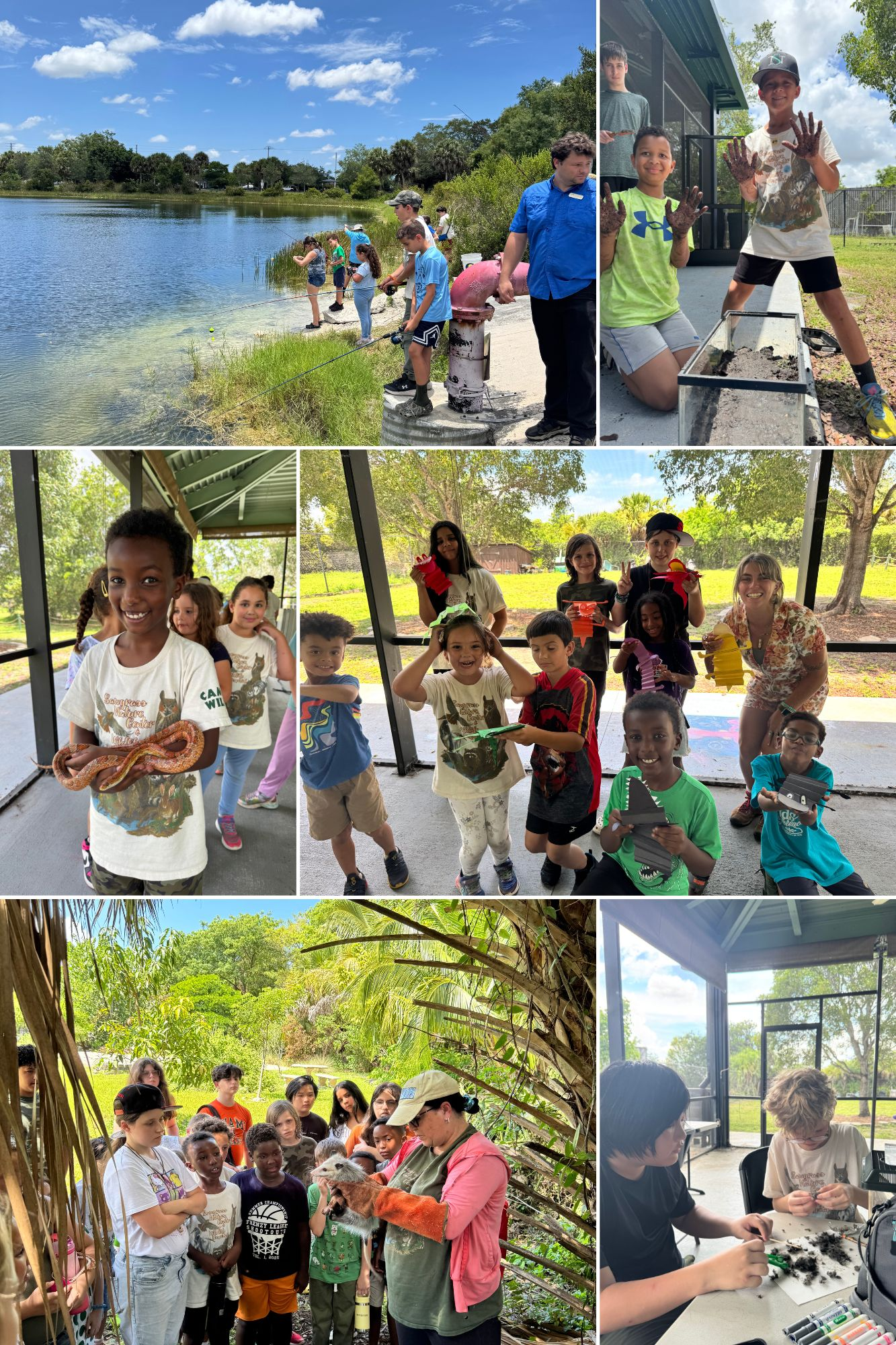
At the Sawgrass Nature Center, we see the value of outdoor environmental education every day. As our own form of environmental education, students are guided through programs that highlight Florida’s native wildlife, their unique adaptations, and the importance of conservation. We host school field trips, offer outdoor nature camps during school breaks, and create opportunities for families to explore nature together. This past summer, our campers got to experience loads of ecology-based lessons and activities. Some of these included trips to the local food forest, the creation of their own nature journals, observing a juvenile opossum release, participating in an ocean acidification experiment, and even dissecting owl pellets! Even a simple self-guided tour of the center
gives visitors a chance to slow down, observe, and learn. These experiences aren’t just fun, but they’re stepping stones toward a more environmentally conscious community.
The lessons children learn outdoors don’t end when the field trip is over or camp comes to a close. They carry forward into adulthood, shaping how people think about their choices, their communities, and their environment. A child who once marveled at a turtle in a pond may grow into an adult who advocates for clean water. A student who planted seeds in a garden may later become a leader in sustainable agriculture or conservation.
Outdoor environmental education matters because it connects us to nature, to each other, and to the responsibility we share in caring for the Earth. Whether it’s planting a tree, volunteering at a local nature center, or simply pausing to notice the clouds drifting overhead, every outdoor learning experience adds to a culture of awareness and stewardship. Together, we can inspire the next generation to build a more sustainable and resilient future.